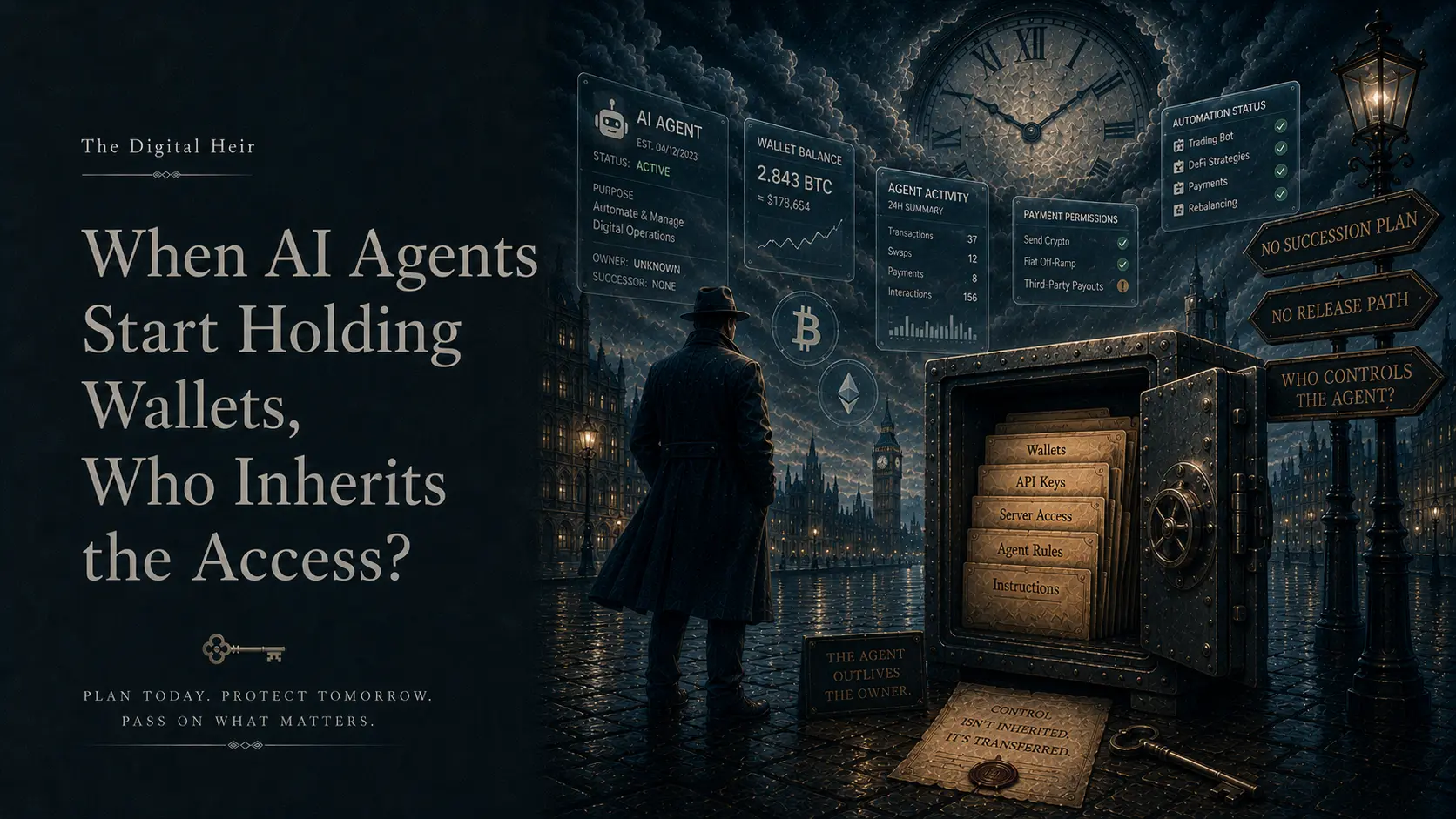
The next digital inheritance problem may not be a wallet.
It may be the agent that controls the wallet.
For years, digital inheritance has mostly meant passwords, cloud accounts, crypto seed phrases, private files, and access to devices. That was already complicated enough. But a new layer is appearing: AI agents that can act on behalf of people and businesses.
They may not only answer emails or summarize documents. They may book services, call APIs, pay invoices, renew subscriptions, manage wallets, interact with dashboards, operate business workflows, and make decisions inside systems their owner no longer touches directly.
That changes the inheritance problem.
If an AI agent can act for you while you are alive, who can recover, stop, or transfer control when you are gone?
The question sounds futuristic. It is not as far away as it looks.
Google has already announced the Agent Payments Protocol, designed for agent-led payments. PayPal has publicly supported the same direction with its own discussion of AP2 and agentic commerce. Coinbase has introduced x402, a protocol for internet-native payments that can let APIs, apps, and AI agents transact directly over HTTP. OpenAI and Stripe have also described an Agentic Commerce Protocol for commerce flows involving AI agents.
This is usually presented as a payments story.
It is also an inheritance story.
Because once software can hold permissions, spend money, access systems, and execute workflows, access to that software becomes part of the estate.
The next digital asset may be the agent itself
People are used to thinking of digital assets as things: a crypto wallet, a domain name, a cloud drive, a password manager vault, a social account, a server, a repository, a Stripe account, an exchange account.
AI agents make the picture less tidy.
The asset may not be only what the agent controls. The agent itself may become important: its configuration, memory, permissions, wallet access, API keys, prompt instructions, business rules, payment limits, connected accounts, and logs of what it has done.
A small business owner may eventually have an agent that handles customer support, pays for API usage, renews hosting, watches analytics, books meetings, and drafts invoices.
A developer may have an agent connected to GitHub, cloud servers, SSH access, deployment pipelines, monitoring tools, crypto wallets, and billing accounts.
A crypto user may have an agent that watches wallets, pays for services, signs limited transactions, manages subscriptions, or interacts with decentralized applications.
A family member looking at this system after the owner’s death may not even know where the “asset” begins. Is it the wallet? The server? The agent account? The API key? The payment policy? The private note explaining how all of it works?
In traditional inheritance, people inherit property.
In digital inheritance, they may also need to inherit control.
Agents will not only hold money. They will hold permissions.
The headline version of this trend is easy to understand: AI agents may be able to pay.
But money is only one part of the issue.
An agent that can pay usually needs permissions. It may need access to a wallet, a card, a stablecoin balance, a merchant account, a payment API, a spending policy, or a signed mandate saying what it is allowed to do.
An agent that operates infrastructure may need SSH keys, cloud credentials, deployment tokens, database access, monitoring credentials, DNS access, or repository permissions.
An agent that helps run a business may need access to invoices, customer records, subscription tools, analytics, CRM systems, email accounts, internal documents, or calendar data.
An agent that manages crypto may need wallet policies, exchange logins, multisig instructions, hardware wallet locations, tax records, bridge history, DeFi positions, or the contact details of someone who understands the setup.
This is why the inheritance problem becomes bigger than crypto.
A seed phrase is already dangerous if it is lost, exposed, or misunderstood. But an AI agent may sit above several systems at once. It may become the operational layer that connects accounts, credentials, money, and automation.
If the owner becomes permanently unavailable, the family may not be looking for one password.
They may be looking for the map.
The risk is orphaned automation
A lost crypto wallet is painful because the assets may become unreachable.
An orphaned agent creates a different kind of problem. It may remain reachable, but nobody knows who should control it.
That is not always dramatic. Sometimes it may simply mean subscriptions keep running, API bills keep accumulating, hosting renews automatically, or a business workflow continues without the person who understood it.
But the stakes can rise quickly.
An agent may have authority to spend within limits. It may interact with customer systems. It may hold access to private files. It may control a server. It may connect to wallets or exchanges. It may operate rules that made sense when the owner was alive but become dangerous after the owner is gone.
The agent does not need to be malicious.
It may simply become ownerless.
That is the strange new risk: not an attacker stealing the keys, but an automated system continuing without a responsible human able to explain, audit, transfer, or shut it down.
The more useful agents become, the more this matters.
Useful agents will not live in isolation. They will be connected to accounts, money, infrastructure, documents, and decisions. That makes them valuable. It also makes them something that should not be left without a succession plan.
Access recovery is not the same as access exposure
The obvious answer sounds simple: give someone access.
But that is rarely safe.
If you give another person full access to your wallets, servers, API keys, business tools, or agent controls while everything is fine, you may create the very risk you were trying to avoid.
Access given too early can be misused, leaked, lost, copied, stolen, or misunderstood. A well-meaning person can store credentials badly. A relative can be pressured. A business partner can leave. A family conflict can turn hostile. A device can be compromised. A seed phrase can end up in cloud notes. An SSH key can be copied into the wrong place.
The opposite approach is also dangerous.
If no one knows the agent exists, no one can recover it. If no one knows what it controls, no one can safely shut it down. If no one knows where the API keys are, a business may lose access to its own systems. If no one knows which wallet funds the agent, crypto may remain visible but unusable. If no one knows which credentials matter, heirs may spend weeks searching through devices, emails, and cloud accounts while automated systems continue to run.
This is the central digital inheritance tension.
Sensitive access should not be exposed too early.
But it should not disappear forever when the owner is no longer there.
That is not only a storage problem. It is a timing problem.
The end of online life is not always clean
Most inheritance tools are built around death.
Real life is messier.
A person can die. But they can also disappear, fall into a coma, become seriously ill, be detained, lose access to devices, suffer cognitive decline, or become unreachable for reasons nobody can immediately prove.
For traditional property, the legal system may eventually catch up. Banks, courts, lawyers, and registries have procedures, even if they are slow.
For digital systems, delay can create damage.
A server can go unpaid.
A domain can expire.
A wallet can become inaccessible.
An API key can keep billing.
A business agent can continue sending messages or taking actions.
A payment automation can remain active.
A family can know that “something digital” exists and still have no idea where control lives.
This is why “after death” is too narrow as the only trigger.
The real question is broader:
What happens at the end of your online life — the moment when you can no longer respond, explain, approve, revoke, rotate, sign, unlock, or shut anything down?
That is the point where digital inheritance begins.
Why this is bigger than crypto
Crypto makes the issue obvious because mistakes are often irreversible. If nobody has the seed phrase, the assets may be gone. If someone exposes the seed phrase, the assets may be stolen. If heirs do not understand the wallet, they may lose funds while trying to recover them.
But the same logic applies to many kinds of sensitive access.
An encrypted note might contain:
- seed phrase locations;
- hardware wallet instructions;
- exchange account details;
- password manager recovery notes;
- SSH keys or server access instructions;
- cloud account recovery steps;
- API key locations;
- AI agent shutdown procedures;
- payment automation rules;
- business continuity instructions;
- trusted technical contacts;
- tax record locations;
- instructions for legal or family representatives.
The category of secret matters less than the timing of release.
Some information should not be shared while the owner is alive and available. But if the owner becomes unavailable, that same information may become essential.
This is the gap ordinary storage does not solve.
A safe can store paper.
A password manager can store credentials.
A cloud drive can store documents.
A hardware wallet can hold keys.
But none of those automatically answers the human question: who should receive the instructions, under what conditions, and how late is too late?
Where The Digital Heir fits
This is the gap The Digital Heir is designed to address: not as a replacement for wallets, password managers, legal documents, servers, or tax planning, but as a conditional delivery layer for sensitive information.
The service gives you an encrypted Envelope. What goes inside is up to you.
It may be crypto recovery information. It may be SSH access notes. It may be API key locations. It may be instructions for shutting down an AI agent. It may be a list of accounts, business workflows, trusted contacts, wallet policies, or emergency steps.
The point is not that every secret belongs in one place.
The point is that some secrets need a release plan.
The Digital Heir is built around that idea. You create an encrypted Envelope in your browser, choose your Digital Heir, define secret questions that person should be able to answer, and set an inactivity Pipeline based on contact channels such as Telegram, email, or WhatsApp.
If you are reachable, nothing needs to be released.
If the Pipeline reaches its end, your Heir receives a limited-time path to try to unlock the Envelope.
That makes the system different from simply giving someone a password today. It is not early exposure. It is conditional access.
And that distinction becomes more important as more of life is delegated to software.
The real question
AI agents may make digital life more convenient. They may also make digital estates harder to understand.
A person used to leave behind accounts.
Now they may leave behind systems.
Some of those systems may hold money. Some may hold permissions. Some may control infrastructure. Some may simply contain the only map that explains how everything fits together.
So the question is not only whether an AI agent can pay, trade, book, renew, deploy, or manage something on your behalf.
The harder question is what happens when you are no longer there to supervise it.
Who can recover control?
Who can shut it down?
Who can transfer it?
Who can audit what it did?
Who can find the instructions?
Who can tell the difference between a useful automation and an ownerless risk?
Digital inheritance is no longer only about passing on files, passwords, or wallets. It is about continuity of control.
If an agent can act for you while you are online, someone needs a safe way to deal with it when you are finally offline.
Because at the end of your online life, access does not become less important.
It becomes everything.