A lot of crypto security advice stops too early.
Buy a hardware wallet. Write down the seed phrase. Put it somewhere safe.
That is often presented as the end of the process. In reality, it is only the beginning.
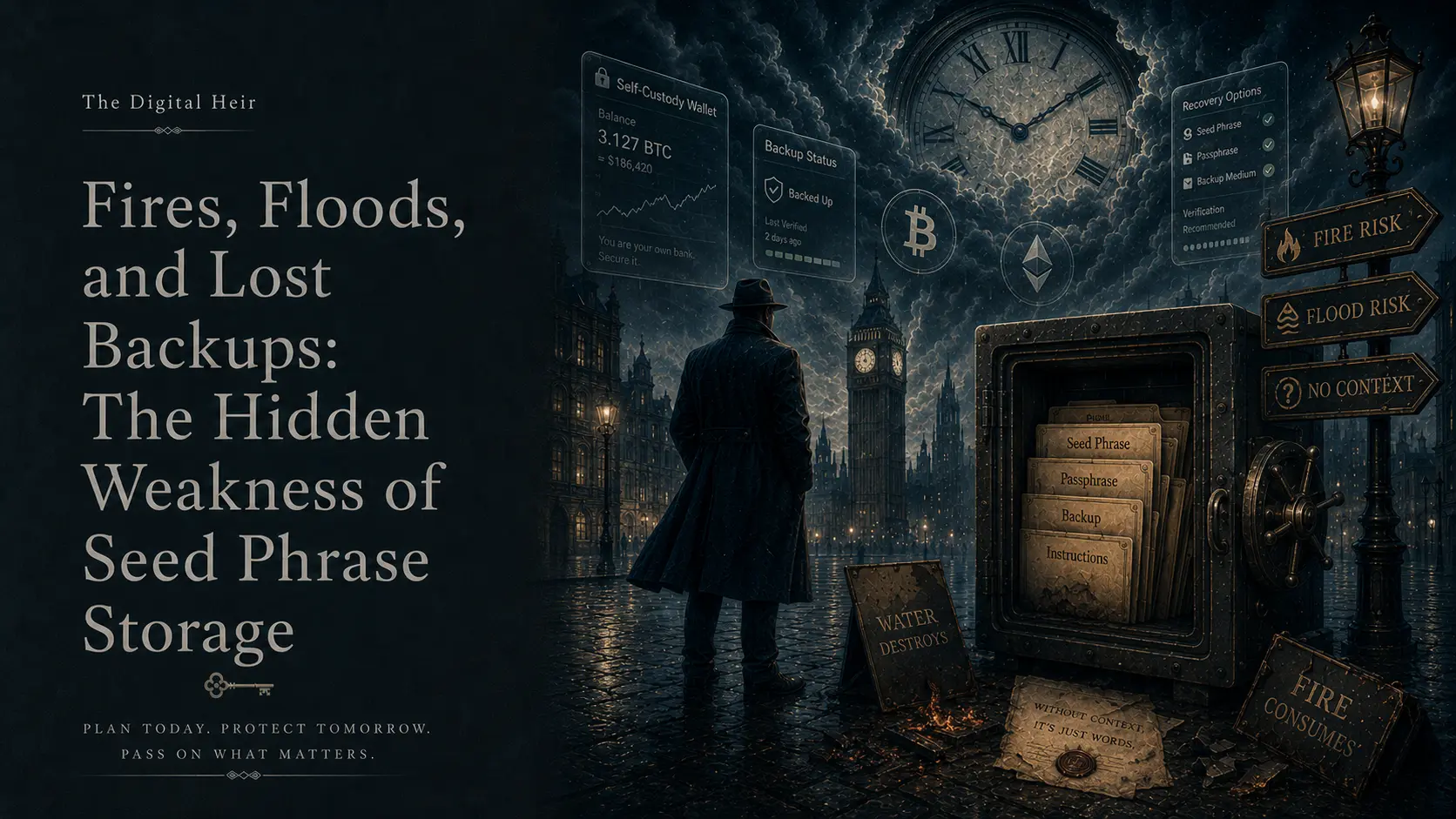
A seed backup is not only a secrecy problem. It is also a durability problem. The same object that protects you from malware may still be destroyed by water, fire, corrosion, physical damage, accidental disposal, or the much simpler disaster of nobody else knowing what it is.
That is where self-custody becomes more fragile than it looks.
A seed phrase can be perfectly offline and still fail. It can survive hackers and fail against a house fire. It can be hidden from thieves and also hidden from heirs. It can be stored on something durable and still become useless if nobody knows which wallet it belongs to, what passphrase is missing, or what should happen next.
Offline storage is important. But offline is not the same as recoverable.
The false comfort of offline storage
Crypto owners often treat “not connected to the internet” as if it means “safe.” It does not. It only means protected from one class of threat.
A seed phrase written on paper and kept away from cloud storage is harder for a remote attacker to steal. That is useful. But physical reality has its own attack surface: fire, flood, mold, corrosion, theft, moving homes, renovation, cleaning, confused relatives, and ordinary human error.
After the California fires in early 2025, Forbes described paper seed phrase storage as a wake-up call for bitcoin owners, noting that paper provides no fire protection and that backup planning matters: Bitcoin Owners: Devastating California Fires Are A Wake-Up Call.
The point is not that paper is always wrong. Paper is simple, cheap, and easy to understand. For many people, it is the first step away from storing secrets in screenshots, cloud notes, email drafts, or password managers they do not fully trust.
But paper has limits. It burns, gets wet, fades, tears, and can be thrown away by someone who does not understand it. It can be found by the wrong person and missed by the right one.
A paper seed phrase may protect against a hacker. It does not automatically protect against time, disaster, or inheritance failure.
When a backup becomes another point of failure
Even wallet makers warn about this.
Ledger’s guide on backup devices says a recovery sheet can be lost or destroyed, and that in a worst-case scenario, a flood or fire can make short work of it. Ledger recommends using a backup device stored in a different location to reduce that risk: Increase Your Security With a Backup Device.
Trezor makes a similar point. Paper templates are useful, but paper is vulnerable to fire, water, and other environmental factors. That is why Trezor discusses more durable backup methods and also recommends redundancy: storing backups in different places because one accident may destroy one copy, while another copy elsewhere might survive: A few tips on storing your recovery seed.
This is the practical problem with simple seed storage: people often imagine one safe location, but one location is still one point of failure.
A drawer can burn. A safe can be stolen. A basement can flood. A storage box can be cleared out. A relative can throw away something that looks like random words. A person can move homes and forget where the backup was placed.
The recovery phrase is not only a cryptographic object. Once written down or engraved, it also becomes a physical object. And physical objects have physical failure modes.
Metal helps, but it does not solve recovery
Metal backups are usually a better answer than paper.
They are designed to survive conditions that paper cannot. Trezor notes that metal backups are generally more resilient and highlights stainless steel or titanium solutions built to withstand fire, corrosion, and other harsh conditions: Metal backups for your Bitcoin.
That is a serious improvement. But “metal” is not a magic word.
Not every product performs the same way. Not every design fails gracefully. Some solutions may survive heat but become hard to read. Others may resist fire but suffer under crush, corrosion, deformation, or poor engraving. Some can remain technically present but practically unrecoverable.
Jameson Lopp’s long-running metal seed storage tests show why this matters. His reviews compare how different backup products behave under stress, including heat, corrosion, and crush testing. Some survive well. Others become noisy, deformed, difficult to read, or effectively unreliable after damage: Metal Bitcoin Seed Storage Reviews.
That changes the question. The issue is not only whether the backup survives. The issue is whether the right person could still recover the funds after a real-world disaster.
A backup that survives but becomes unreadable is a bad backup. A backup that survives but nobody can identify is a bad backup. A backup that survives but exists only in one location is a fragile backup. And a backup that survives physically but dies socially — because no heir knows it exists, what wallet it belongs to, or what to do next — is still a failed backup.
The missing ingredient is context
Seed storage advice often focuses on the object: paper, steel, titanium, hardware wallet, safe, vault, bank box, hidden compartment.
But the object is only part of the recovery system. The person using it needs context.
They need to know what the words are. They need to know which wallet they restore. They need to know whether there is an additional passphrase. They need to know which chains or accounts matter. They need to know whether there are multiple wallets, multiple backups, or a multisig setup. They need to know what not to type into a website. They need to know whom to ask for help before making a mistake.
Without context, even a physically intact backup can become dangerous.
An heir may find 24 words and not know what they mean. They may enter them into a fake recovery site. They may restore the wallet but miss assets on other networks. They may ignore a passphrase and think the wallet is empty. They may move funds before tax records are collected. They may show the backup to the wrong “technical” person. They may throw the object away because it looks like scrap metal, a puzzle, or an old note.
This is why physical seed storage is necessary but not sufficient. It can preserve access material. It does not automatically preserve meaning.
Why physical storage fails inheritance
This is where the problem becomes bigger than storage hardware.
A seed phrase backup is usually designed around the owner. It assumes the person recovering the wallet already knows what they are doing, what the backup is, where the wallet is, and why the words matter.
Inheritance is different.
The person who needs the backup may not be the person who created it. They may be grieving, confused, under legal pressure, dealing with family conflict, and unfamiliar with crypto. They may not know whether the seed phrase is the whole answer or only one part of the answer.
That is why a drawer, safe, or metal plate cannot be the entire plan.
Physical storage can protect against remote attackers. It can improve survival against fire or water. It can reduce the chance that one device failure destroys access. But it does not decide when someone should be told. It does not verify that the owner is gone or unreachable. It does not tell the heir what steps to take. It does not connect the technical recovery process with the legal and human reality of inheritance.
The real challenge is not only how to keep sensitive access information offline. It is how to keep it protected now and still transferable later under conditions the owner chooses.
Paper can burn, metal can fail in edge cases, devices can be lost, and backups can become separated from the context that makes them useful. All of that becomes worse when the owner is suddenly unavailable.
Where The Digital Heir fits
This is the gap The Digital Heir is designed to address: not as a replacement for physical seed storage, a hardware wallet, a lawyer, or tax planning, but as a conditional delivery layer for sensitive recovery information.
Physical backups can help preserve the seed phrase. The Digital Heir is about something different: delivering the right instructions to the right person only if the owner becomes unavailable.
An encrypted Envelope can contain the context that physical storage cannot provide by itself: where the backup is stored, which wallet it belongs to, whether there is a passphrase, which exchanges or accounts exist, who should help, where tax records are kept, and what mistakes the heir must avoid.
The point is not to expose the seed phrase too early. The point is to avoid the opposite failure: protecting the backup so well that nobody can use it when it matters.
A strong recovery plan may include paper, metal, hardware wallets, multiple locations, legal documents, and trusted people. But if the plan does not explain how access information should be released when the owner is gone, missing, incapacitated, or unreachable, it still has a hole in it.
Crypto inheritance is not just storage. It is timing, context, and controlled delivery.
The real question
The question is not only whether your seed phrase can survive a hacker. The better question is whether your recovery setup can survive real life.
If your home burned down tomorrow, would your crypto recovery setup still work? If your phone was destroyed, would you know where the backup is? If your paper copy was lost, would there be another path? If your metal backup survived, would anyone else know what it means? And if you were no longer here to explain the system, could the right person recover the assets safely?
A seed phrase is not a plan by itself. It is only one piece of a plan.
Without durability, it can be destroyed. Without context, it can be misunderstood. Without inheritance planning, it can die with the owner.
And in crypto, a backup that cannot be used at the right moment is not really a backup.