Crypto introduced a new level of freedom.
Not freedom as a slogan, and not freedom as a decoration for a financial product. Something more practical: the ability to hold and move value without asking a chain of authorities for permission.
It restored, in digital form, an older idea of ownership. If you had gold coins in your pocket, the value was with you. You could carry it, hide it, give it, protect it, or lose it. Nobody had to approve a withdrawal. No platform had to keep your account open. No clerk had to confirm that the balance belonged to you before the object in your hand meant something.
Crypto carried part of that old logic into the online world.
At meaningful scale, it became possible for a person to hold serious value digitally without relying entirely on banks, brokers, payment processors, custodians, frozen accounts, withdrawal approvals, office hours, or someone else deciding whether access to their own assets was convenient.
That was the spirit of self-custody: ownership outside the usual authority structures.
Your keys, your coins.
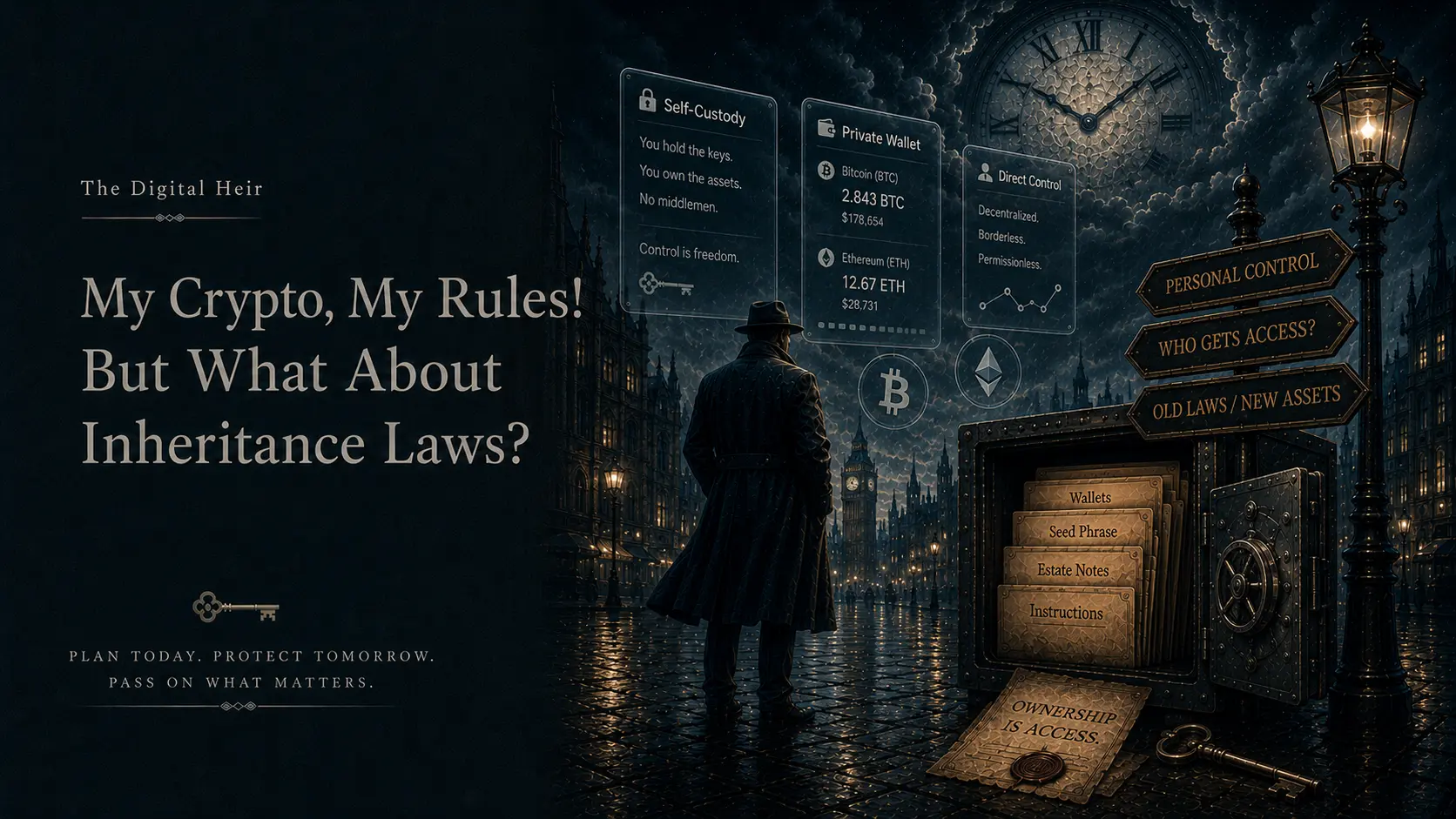
My crypto, my rules.
But inheritance changes the sentence.
When the owner is gone, missing, incapacitated, unreachable, or simply unable to explain anything, private freedom becomes someone else’s practical problem. A wallet can hold real value and still become useless to the people standing in front of a locked laptop, a steel backup plate, and no idea what any of it means.
That is where two systems collide.
One system is built around paperwork.
The other is built around access.
Inheritance was built for assets institutions can reach
Traditional inheritance systems were designed around assets that can be identified, registered, frozen, valued, transferred, taxed, and disputed.
A house sits in a registry. A car has papers. A bank account belongs to a bank. A brokerage account has a custodian. A business has contracts, shares, records, offices, and people who can be brought into a process.
These assets live inside visible structures. That structure can be slow, expensive, public, and frustrating, but it gives the legal machinery something to work with. The asset is somewhere. Someone administers it. Someone can be ordered to transfer it. Someone can block it, value it, or place it inside a formal estate process.
That system is not meaningless. It exists to solve real problems: fraud, family conflict, creditors, taxes, unclear wills, and the disorder that can follow death.
But a system designed for order is not always designed for personal will.
It may protect the average case while failing the individual one. It may be lawful and still slow. It may be official and still expensive. It may produce an answer and still drift far from what the owner privately wanted.
With physical assets, there is often no clean escape from that machinery. The house is still in the registry. The account is still at the bank. The car is still registered somewhere. Even when the process is painful, the asset remains inside a system that knows how to touch it.
Self-custodied crypto does not always stay within that reach.
A wallet can be visible on-chain and still be unreachable to everyone who matters.
The asset may exist.
The path may not.
Self-custody moves ownership from permission to access
A private wallet does not behave like a house, a bank account, or a brokerage account.
It does not ask for a death certificate. It does not read a will. It does not wait for probate. It does not know who the default heirs are. It does not know who cared for the owner, who understood their wishes, who should be trusted, or who should never be allowed near the asset.
It recognizes access.
That is the freedom crypto introduced. It is also the danger.
If you hold the key, you can move the value. If someone else receives the key too early, they can move it too. If nobody receives the key after you are gone, nobody inherits anything in practice.
The system does not protect intention.
It enforces access.
That is why self-custody is not only a security model. It is a responsibility model. And inheritance is where that responsibility stops being theoretical.
“My crypto, my rules” is easy while you are there
While the owner is alive and available, the phrase makes sense.
You decide where the assets are held. You decide who knows. You decide whether anything is written down. You decide whether to trust a hardware wallet, a seed phrase, a multisig setup, an exchange, a safe, a lawyer, a password manager, or nobody at all.
That is the point.
But once you are gone, missing, incapacitated, detained, unreachable, or unable to answer, your freedom has to become something else.
It has to become a path.
Someone has to know what exists. Someone has to know where the instructions are. Someone has to know what not to touch. Someone has to understand whether there is a seed phrase, a passphrase, a hardware wallet, an exchange account, a multisig policy, a tax record, a technical helper, or a warning that says: do not move anything before speaking to this person.
Without that path, “my crypto, my rules” becomes a slogan locked inside a wallet nobody can open.
The legal world can say who is entitled.
But entitlement does not sign a transaction.
A court can recognize an heir.
It cannot guess a seed phrase.
A notary can preserve a document.
It cannot reconstruct the missing context around a wallet.
A will can express intent.
It cannot make a blockchain care.
The legal system may know the asset exists and still be unable to move it
This is where crypto inheritance becomes unusual.
Crypto does not make law disappear. It does not make taxes disappear. It does not make family disputes disappear. It does not make every private instruction automatically superior to every formal process.
But it does introduce a layer that traditional estate systems were not built to operate directly: access.
With physical assets, the system can usually reach the asset after the owner is gone. It can freeze a bank account. It can record a house transfer. It can block a sale. It can pull the asset into a formal process.
With self-custodied crypto, the system may know the asset exists and still be unable to move it.
That creates a strange reversal.
In institutional inheritance, the danger is often that too many people can interfere.
In crypto inheritance, the danger may be that nobody can act at all.
That is not freedom anymore.
That is disappearance.
The serious question is not whether crypto can escape every rule. That is the wrong argument.
The serious question is whether the person you choose will receive the access path before your intention disappears forever.
Freedom without preparation becomes loss
There is a loud version of “my crypto, my rules” that stops at defiance.
It is not enough.
The stronger version accepts the responsibility that comes with control.
If you believe in self-custody, you accept that the burden is yours. Not only the pleasant part, where you can move value without permission, but also the uncomfortable part, where you must decide what happens if you can no longer act.
Freedom without preparation can become loss.
Secrecy without a release path can become accidental destruction.
A private key protected from everyone can also be protected from the only person who should receive it.
That is the paradox.
Reveal too early, and you create risk while you are alive.
Reveal too late, and the asset may be unreachable.
Reveal never, and your wishes die with you.
Crypto gives you a real choice. But a real choice has to be designed.
We do not decide what belongs inside your Envelope
This is where The Digital Heir fits.
Not because someone else should decide what matters.
Because the opposite is true.
The Digital Heir is built around a simple principle: we do not tell you what your important information is.
We do not tell you what you are allowed to protect.
We do not tell you whether your encrypted Envelope should contain a seed phrase location, exchange account notes, hardware wallet instructions, SSH key references, server access steps, API key locations, AI agent shutdown instructions, password manager guidance, tax-record locations, personal messages, or something else entirely.
That decision belongs to you.
The service exists for a narrower purpose: to let you prepare an encrypted Envelope, keep it sealed, and create a conditional path for the person you chose to try to unlock it if you become unavailable.
Your assets.
Your instructions.
Your trusted person.
Your timing.
Digital inheritance is bigger than crypto
Crypto makes the problem obvious because access is unforgiving. But the same logic applies to many other digital things.
A server can be lost because nobody has SSH access. A domain can expire because nobody knows the registrar. An AI agent can keep running because nobody knows how to shut it down. A business account can become inaccessible because the only recovery email belonged to the founder. A password manager can contain everything and still be useless if nobody knows how emergency access is supposed to work.
Sometimes the most valuable thing is not the password itself.
It is the map.
Where things are. What matters. Who to call. What not to do. What must happen first. What should never be exposed early.
Digital inheritance is not only about storing secrets.
It is about preserving meaning.
The hard part is timing
A safe can store paper. A hardware wallet can hold keys. A password manager can store credentials. A notary can hold documents.
But none of them naturally solves the hardest question:
When should secrecy end?
While you are alive and reachable, sensitive access should stay protected. If you become unavailable, the instructions should not vanish with you.
A drawer does not know the difference. A safe does not know whether you are alive. A legal document does not know where the wallet is. A password manager does not understand why one person should know now and another person should never know.
Digital inheritance needs controlled release.
Not public exposure.
Not blind trust.
Not giving someone everything today.
A release path.
Where The Digital Heir fits
The Digital Heir is built for that release path.
It does not replace a lawyer. It does not replace tax planning. It does not decide who is legally entitled to anything.
It does something narrower and more practical: it helps you prepare encrypted instructions and conditionally deliver them if you become unavailable.
The owner creates an encrypted Envelope in the browser, decides what belongs inside, chooses the Heir, and defines an inactivity Pipeline through available contact channels such as Telegram, email, or WhatsApp.
If the owner remains reachable, nothing is released.
If the Pipeline reaches its end, the Heir receives a limited-time path to try to unlock the Envelope using the secret answer route the owner prepared.
So yes, there is a question.
But it is not the question of a clerk behind a desk.
It is the question you chose — the one your Heir should know and an outsider should not.
That is the difference between giving away control today and preparing access for tomorrow.
The real question
Crypto brought back an almost forgotten kind of ownership: value held by the person, not merely recorded on their behalf.
But ownership is incomplete if it only works while the owner is alive, healthy, and online.
Traditional inheritance asks who should receive the asset.
Self-custody asks something more immediate:
Who has the path?
If your answer is “nobody,” then the rules may not matter.
The asset may not be stolen.
It may not be seized.
It may not be transferred to the wrong person.
It may simply become unreachable.
And in digital inheritance, unreachable is not a legal outcome.
It is the end of the story.