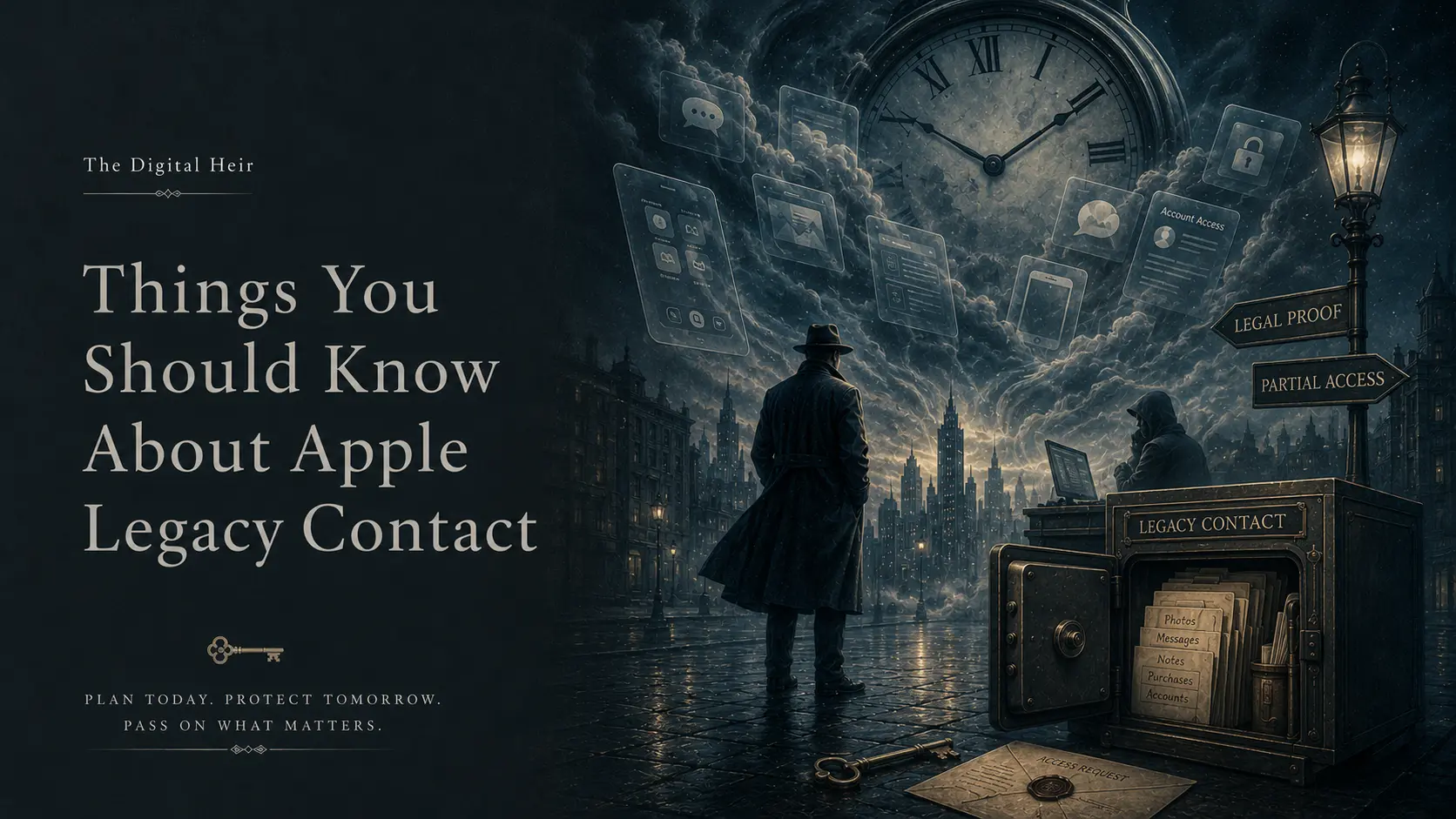
Apple already has a Legacy Contact feature.
That is both progress and a warning sign.
It is progress because even Apple now treats digital inheritance as a real problem.
You can choose a person, generate an access key, and give them a path to request access to certain data in your Apple Account after your death.
But it is also a good example of the limits of platform-controlled inheritance.
1. Apple Legacy Contact depends on legal proof
Apple’s model is built around confirmed death.
Your Legacy Contact needs both the access key and a death certificate to request access.
That makes sense for Apple. It reduces fraud, prevents premature access, and fits the legal structure around deceased users.
But real life is not always that clean.
What if someone disappears?
What if they are in a coma?
What if they are detained, unreachable, or unable to communicate?
What if something serious has happened, but there is no death certificate yet?
In these situations, the legal system may take a long time to catch up. A tool that only works after documented death may be too narrow for many real-world inheritance and emergency-access scenarios.
2. Access is not total
Apple does not give your Legacy Contact unlimited access to everything.
The feature can provide access to certain account data, but some categories remain unavailable.
One important example is iCloud Keychain data, including passwords, passkeys, and payment information.
That matters because for many people, the most important “digital inheritance” is not photos or notes.
It is access.
Access to accounts.
Access to recovery paths.
Access to instructions.
Access to digital assets.
If the tool cannot transfer the most sensitive access layer, it may solve only part of the problem.
3. Apple decides what can and cannot be transferred
This is the core tradeoff.
Apple Legacy Contact is convenient because it is built into the Apple ecosystem.
But that also means Apple defines the rules.
Apple decides what data is available.
Apple decides the request process.
Apple decides what proof is required.
Apple decides what remains inaccessible.
For many normal users, that is acceptable. For family photos, notes, device backups, and standard consumer data, this may be enough.
But if you need a plan for private instructions, crypto recovery information, account recovery logic, or highly specific inheritance conditions, Apple’s model may be too rigid.
4. It is useful for account continuity
This is not a criticism of the feature itself.
Apple Legacy Contact is useful.
If your goal is to help your family access parts of your Apple account after officially documented death, it is a real tool and probably worth setting up.
It is much better than leaving relatives with no plan, no access key, no instructions, and no idea where to start.
For Apple users, it can be one part of a digital estate plan.
But one part is not the whole plan.
5. It does not handle flexible release conditions
Digital inheritance is not always only about death.
Sometimes the real problem is prolonged silence.
Or a failed check-in.
Or a sequence of events that strongly suggests something is wrong.
A platform-controlled legacy tool usually does not let you build your own release logic.
You cannot say:
“If I am not online for 7 days, send me a message.”
“If I do not respond, try another channel.”
“If all checks fail, send a protected access link to this person.”
That kind of controlled release is a different model.
It is closer to a digital inheritance pipeline than a simple death-based account recovery feature.
6. Big platforms prove the problem is real
This is the most interesting part.
When Apple builds Legacy Contact, it confirms that digital inheritance is no longer a strange niche concern.
It is a mainstream problem.
People live inside digital accounts now.
Their photos, documents, messages, payments, notes, recovery paths, and identity traces are all locked behind platforms.
But platform tools are designed around platform rules.
They are useful, but incomplete.
Final thought
Apple Legacy Contact is a good step.
It helps families access parts of an Apple account after documented death.
But if your goal is to pass on digital inheritance the way you want, under your own conditions, and not only after a large corporation and legal paperwork decide the moment has come, then it is a much narrower solution than it first appears.
The question is not whether Apple Legacy Contact is useful.
It is.
The question is whether it is enough.
Source: Apple Support — How to add a Legacy Contact for your Apple Account
One possible approach for access and digital inheritance: The Digital Heir